inquiry
伝言を残す
弊社の製品にご興味があり、詳細を知りたい場合は、こちらにメッセージを残してください。できるだけ早く返信させていただきます。
提出する
バナー

ブログ

ブログ

  • 自動車補修用コーティング工場の内部:WASHINTAの品質保証方法
    自動車補修用コーティング工場の内部:WASHINTAの品質保証方法
    Aug 27, 2025
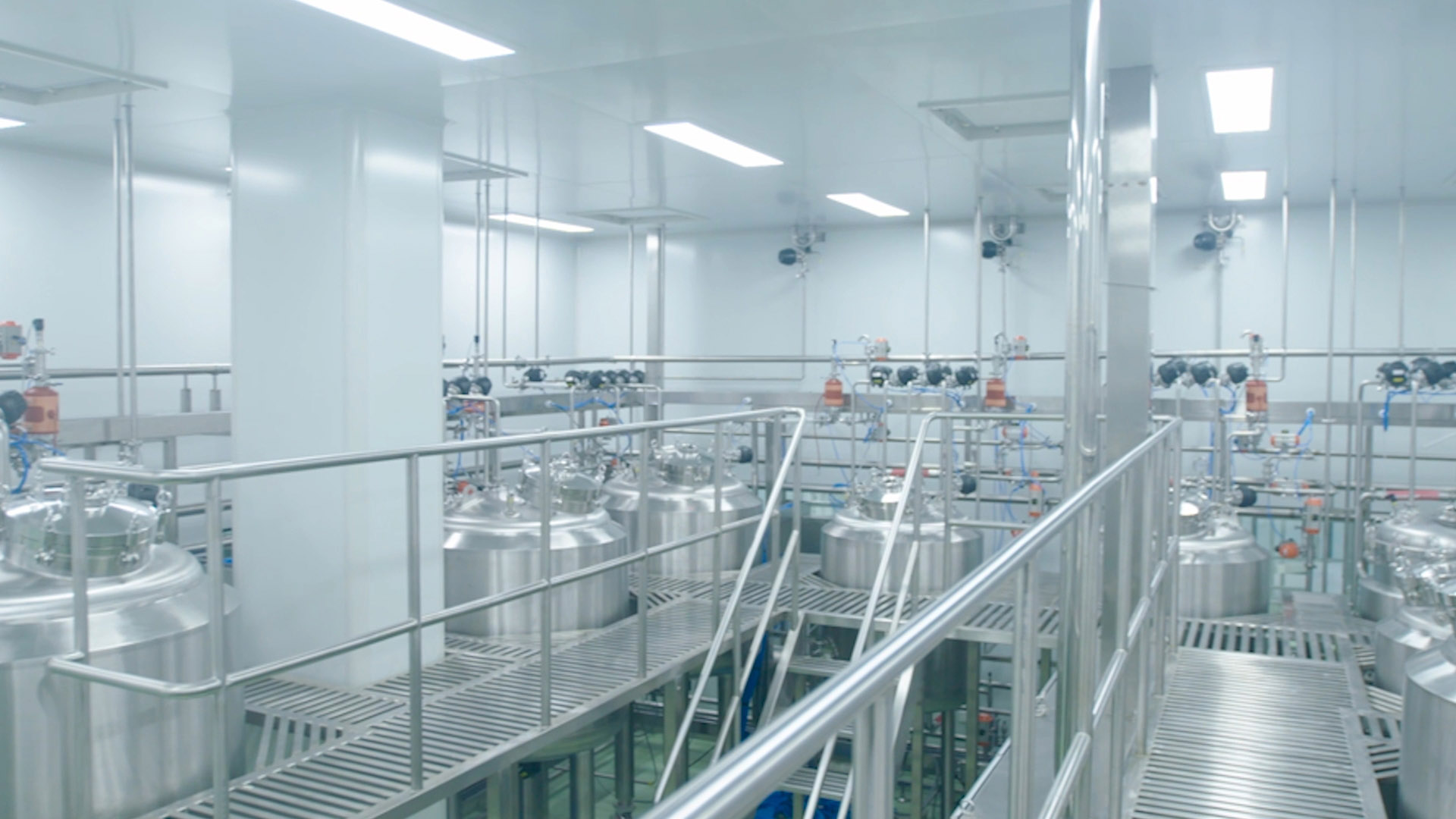
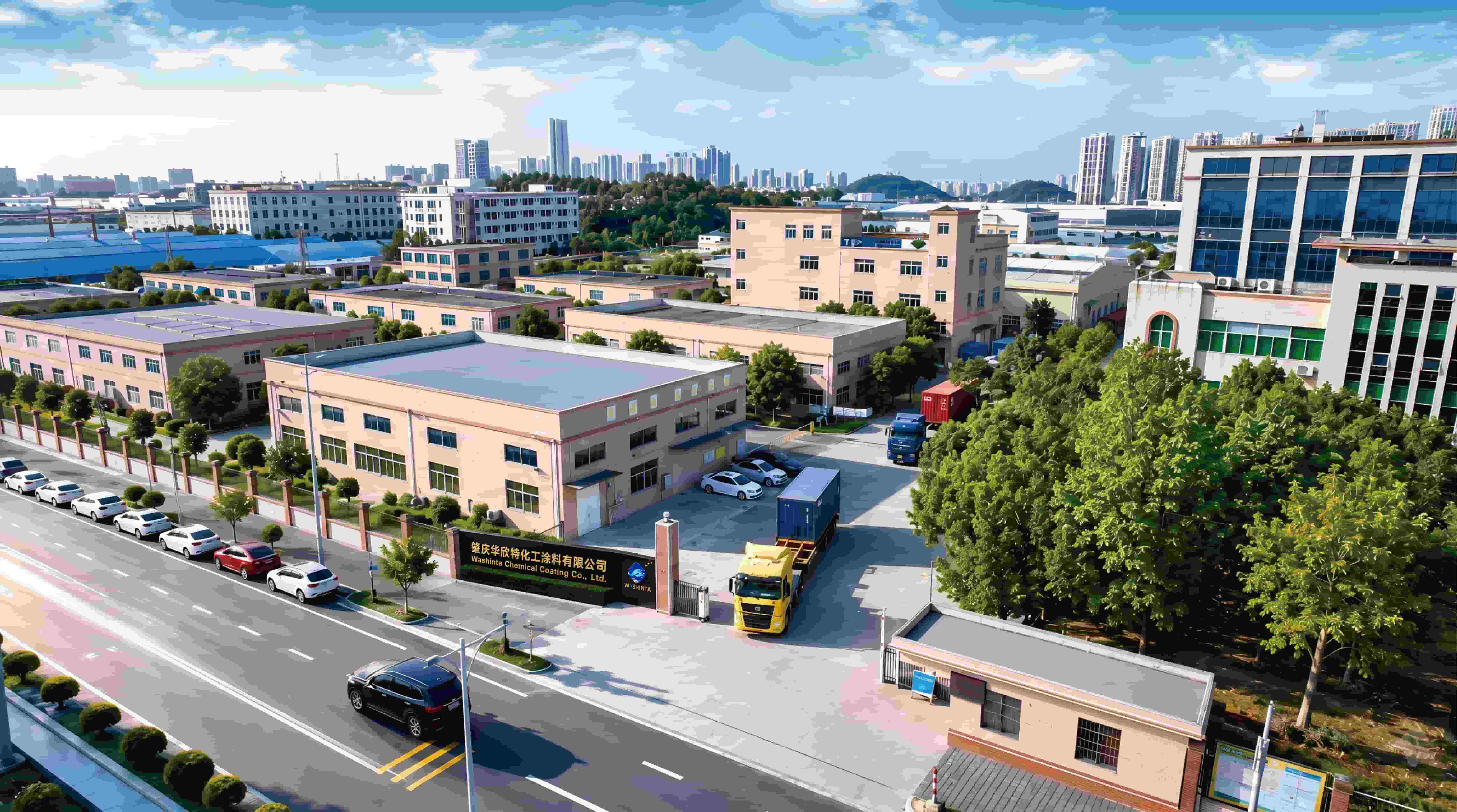
    自動車補修塗料業界では、製品の品質がお客様の意思決定における重要な要素となります。70カ国以上に輸出する補修塗料の専門メーカーとして、WASHINTAは常に品質管理を最優先に考えています。本日は、当社の工場「内部」をご案内し、すべての補修塗料が最高水準を満たしていることをどのように保証しているかをご紹介します。 1. 原材料の厳選 品質保証はソースから始まります: 当社の着色剤、樹脂、添加剤、溶剤はすべて世界的に有名なサプライヤーから仕入れています。 原材料の各バッチは、当社の基準に準拠していることを確認するために、工場に入る前に化学組成分析、安定性テスト、色検査を受けます。 このステップにより、コーティングの基本的な性能と長期的な色の安定性が保証されます。 2. 高度な生産設備 すべてのバッチで均一性と一貫性を保証するために、当社は最新の生産ラインに投資しました。 着色剤と樹脂の完全な混合を保証する全自動分散システム。 各缶の正確な容量と比率を保証する高精度充填装置。 密閉された生産環境により、ほこりや汚染を防ぎ、純粋なコーティングを保証します。 高度な自動化により、人的エラーが削減され、安定した信頼性の高い製品パフォーマンスが保証されます。 3. 厳格なプロセス管理 すべての製造ステップは厳格なプロセス基準に従っています。 温度、湿度、混合速度が正確に制御されます。 異なるタイプのコーティング(無地、パール、水性)は、独立した製造プロセスに従います。 すべてのバッチは、粘度、乾燥時間、光沢、接着テストなどの品質検査を受けます。 すべてのテストに合格した製品だけが次の段階に進みます。 4. 包括的な品質テスト 当研究室には最先端の機器が備えられています。 標準サンプルとの色の一致を確認するための分光光度計。 高温・低温・高湿度下でのコーティングの安定性を確認する耐候性試験装置。 接着性、硬度、耐衝撃性を評価するための機械的性能テスト。 すべてのコーティング缶は、顧客の手に渡った際に優れた性能を発揮できるよう、複数のテストを受けています。 5. 継続的な改善と研究開発サポート 品質は生産管理だけでなく、継続的な研究開発にも依存します。 当社の専門的な研究開発チームは、カラーマッチングの精度とコーティングの耐久性を向上させるために、配合を継続的に最適化しています。 顧客からのフィードバックは生産プロセスの改善に直接活用され、閉ループ品質管理システムを形成します。 新しい材料と技術の応用により、当社の製品は市場の最前線に留まります。 結論 自動車補修コーティングの品質が修理結果と顧客満足度を決定します。原材料の選択、生産設備、プロセス制御から厳格なテストや研究開発サポートまで、あらゆるステップで厳格な管理を通じて、あらゆるコーティング缶の高品質を保証します。 専門的な補修コーティングメーカーを選択することは、信頼性、安全性、効率性を選択することを意味します。
    続きを読む
  • MEET WASHINTA AT SEMA SHOW 2026!
    MEET WASHINTA AT SEMA SHOW 2026!
    Sep 15, 2026
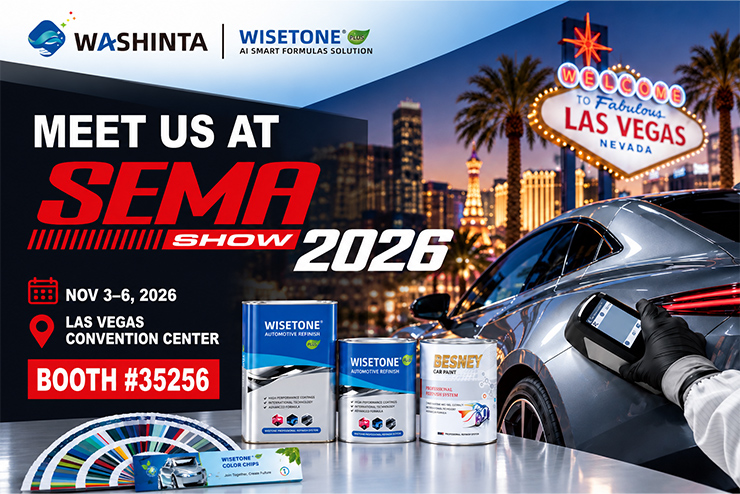
      Smarter color matching. Faster refinishing. Modern body shops need more than paint — they need a smarter way to match colors and get vehicles back on the road. At SEMA Show 2026, discover Washinta’s AI-powered color formulation system, designed to make automotive refinishing more efficient and precise. 🔹 100,000+ color formulas🔹 14 languages🔹 ΔE < 1.0 color accuracy🔹 Daily formula updates Our color database is continuously updated to help body shops keep up with today’s rapidly changing vehicle colors, including a strong focus on Chinese EV/NEV colors. 📅 NOV 3–6, 2026📍 Las Vegas Convention Center🎯 BOOTH #35256 Come meet our team, explore our color-matching solutions, and discuss how Washinta can support your body shop or distribution business. 👉 See you at SEMA 2026! Washinta Chemical Coating Co., Ltd.www.washinta.com
    続きを読む
  • Fast-Dry Clearcoat vs Standard Clearcoat: Which Is Better for Modern Body Shops?
    Fast-Dry Clearcoat vs Standard Clearcoat: Which Is Better for Modern Body Shops?
    Sep 11, 2026
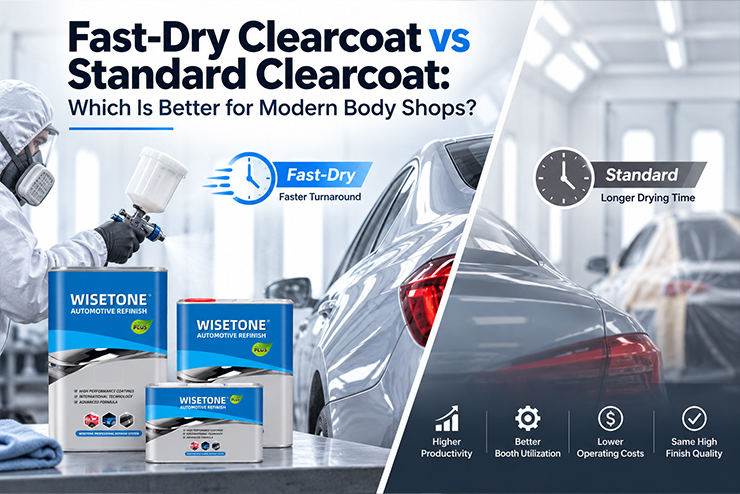
    In automotive refinishing, clearcoat does much more than create gloss. It protects the basecoat, contributes to the final appearance, affects polishing and handling time, and plays an important role in the overall repair cycle. For modern body shops, however, another factor is becoming increasingly important: Speed. As repair volumes increase and customers expect faster vehicle delivery, body shops are looking for ways to shorten cycle times without sacrificing finish quality. This has increased interest in fast-dry clearcoats. But does faster always mean better? And should every body shop replace its standard clearcoat with a fast-dry system? The answer depends on the repair environment, application requirements, climate, production volume, and workflow of the shop. In this article, we compare fast-dry clearcoat vs standard clearcoat and explain which solution may be better for different automotive refinishing operations. What Is a Standard Automotive Clearcoat? A standard clearcoat is designed to provide a balanced combination of: • Gloss • Flow and leveling • Durability • Application flexibility • Working time • Appearance • Weather resistance Depending on the product and repair conditions, standard clearcoats generally allow painters more time for application and leveling before the coating begins to cure. This can be particularly useful for: Larger repair areas Full-panel or multi-panel refinishing Higher ambient temperatures Jobs where maximum flow and appearance are the priority Standard clearcoats remain an important part of professional automotive refinishing because they provide a broad application window and can perform well across many different repair situations. What Is a Fast-Dry Clearcoat? A fast-dry clearcoat is formulated to reach key handling or finishing stages more quickly. Depending on the specific product, this may include faster: • Flash-off • Drying • Hardness development • Cooling-to-polishing time • Assembly time • Vehicle turnaround The objective is simple: Reduce the time between spraying the clearcoat and moving the vehicle to the next stage of the repair process. For high-volume collision centers and body shops, this can have significant operational value. Instead of asking only: “How good does the clearcoat look?” modern shops increasingly ask: “How quickly can I finish this vehicle and move the next job through the booth?” Fast-Dry vs Standard Clearcoat: Key Differences The exact performance depends on the formulation and application conditions, but the general differences can be summarized as follows: Factor Standard Clearcoat Fast-Dry Clearcoat Drying Speed Standard Faster Hardness Development Gradual Faster Polishing Availability Usually later Usually earlier Booth Turnaround Standard Faster Working Time Often longer May be shorter Large Repair Areas Often suitable Product-dependent Spot / Panel Repairs Suitable Particularly efficient High-Volume Shops Good Strong advantage Energy-Saving Potential Standard Potentially higher Application Technique Conventional May require tighter process control This does not mean one technology is automatically better. The correct choice depends on what the body shop needs to achieve. Why Fast-Dry Clearcoats Are Becoming More Important 1. Faster Vehicle Turnaround For many modern body shops, cycle time is a critical performance indicator. A vehicle sitting in the shop waiting for clearcoat to dry is occupying production space. If the clearcoat can reach polishing or assembly readiness sooner, the repair can move to the next stage faster. A simplified workflow looks like: Spray ↓ Bake / Dry ↓ Cool ↓ Polish ↓ Assemble ↓ Deliver Reducing the drying stage can shorten the entire repair cycle. This is especially valuable for high-volume repair centers where multiple vehicles must move through the same spray booth every day. 2. Better Spray Booth Utilization A spray booth is one of the most expensive pieces of equipment in a body shop. It is also a production bottleneck. If a vehicle remains inside the booth for a long drying cycle, the next job must wait. A faster clearcoat system can help reduce booth occupancy. For example: Longer Drying Cycle → Fewer available booth slots while: Shorter Drying Cycle → Faster booth turnover → More potential repair capacity For busy shops, saving time on each repair can accumulate into meaningful productivity gains over a week or month. 3. Earlier Polishing and Assembly Dry-to-touch is not the same as ready-to-polish. This distinction matters. A clearcoat may appear dry on the surface but still be too soft for polishing, assembly, or handling. A high-performance fast-dry clearcoat should therefore not only dry quickly—it should also develop usable hardness efficiently. Earlier hardness development can allow technicians to: • Polish sooner • Remove masking sooner • Begin assembly sooner • Reduce waiting time between departments • Deliver vehicles faster For body shops, this can be more valuable than drying speed alone. 4. Potential Energy Savings Traditional automotive refinishing often relies on heated spray booth cycles. Heating a booth consumes energy. If a clearcoat can achieve the required performance with a shorter bake cycle—or develop sufficient hardness efficiently at ambient temperature—the shop may reduce energy consumption per repair. The potential saving depends on: • Booth type • Energy source • Local energy prices • Bake temperature • Bake duration • Number of repairs Therefore, fast drying should not automatically be marketed as “low energy.” However, in the right production environment, shorter curing cycles can contribute to improved energy efficiency. 5. More Predictable Production Scheduling Body shops operate more efficiently when repair times are predictable. If a clearcoat requires a long or highly variable curing period before polishing, scheduling becomes more difficult. A predictable fast-dry system can make it easier for production managers to estimate: When will the vehicle leave the booth? When can polishing begin? When can assembly begin? When can the customer collect the vehicle? Predictability can be almost as important as speed. Where Standard Clearcoat Still Has Advantages Fast drying is attractive, but it is not automatically the best solution for every repair. Standard clearcoats continue to offer important advantages. 1. Larger Repair Areas For larger panels or multi-panel repairs, painters may benefit from a longer working window. A clearcoat that reacts too quickly under certain conditions can make application more demanding. Standard systems may provide more comfortable application time for large repair areas. 2. Hot Working Environments Ambient temperature can significantly affect clearcoat behavior. In hot climates, a very fast system may become more difficult to control unless the correct hardener, thinner, and application process are used. Body shops in high-temperature markets should evaluate the entire clearcoat system rather than choosing based on drying speed alone. 3. Maximum Flow and Leveling Some premium refinishing jobs prioritize appearance above cycle time. For these applications, painters may prefer a system with more open time to achieve excellent leveling and surface appearance. The best clearcoat is therefore not always the fastest clearcoat. It is the clearcoat that best matches the repair objective. What Should Body Shops Look for in a Fast-Dry Clearcoat? When evaluating a fast-dry clearcoat, do not focus only on the headline drying time. Consider the complete performance package. Drying Time How quickly does the clearcoat cure under the specified conditions? Check whether the technical data refers to: • Dust-free time • Touch-dry time • Assembly time • Polishing time • Full cure These are different performance stages. Hardness Development A useful fast-dry clearcoat should build hardness efficiently, not simply become surface-dry. This is particularly important for polishing and vehicle assembly. Gloss and DOI Speed should not come at the expense of appearance. A professional clearcoat should still provide strong gloss, clarity, leveling, and image definition. Application Window Consider whether the product remains manageable across: • Different repair sizes • Different painters • Different temperatures • Different humidity levels Polishing Performance For fast-turnaround shops, early polishing performance can be a major advantage. The clearcoat should reach a condition where defects can be corrected without excessive softness or polishing difficulty. Durability Fast curing should not mean short service life. A professional automotive clearcoat still needs appropriate resistance to weathering, chemicals, scratches, and normal environmental exposure. Which Clearcoat Is Better for Your Body Shop? The answer depends on your business model. High-Volume Collision Repair Center A fast-dry clearcoat can be particularly valuable when booth capacity and vehicle turnaround are major priorities. Express Repair / Spot Repair Operation Fast drying can help support same-day or rapid repair workflows. General Body Shop A balanced clearcoat with good application flexibility and reasonable drying speed may provide the best overall solution. Premium Refinishing Shop Where maximum appearance and large repair areas are common, a standard or premium high-performance clearcoat with excellent flow may remain preferable. Hot-Climate Market The complete system—including hardener and thinner selection—becomes especially important. Application control may matter more than simply choosing the fastest product. The decision should therefore be based on: Repair Type + Shop Volume + Climate + Painter Preference + Booth Capacity + Required Finish not simply: Fast vs Slow Calculate Clearcoat Value by Cost per Repair, Not Cost per Liter This is particularly important for body shop owners and automotive paint distributors. Suppose Clearcoat A costs less per liter than Clearcoat B. At first glance, Clearcoat A appears more economical. But what if Clearcoat B allows the shop to: • Finish drying sooner • Polish earlier • Free the booth faster • Reduce energy consumption • Complete more vehicles • Reduce overtime The calculation changes. Instead of looking only at: Clearcoat Price per Liter consider: Material Cost Booth Time Energy Technician Time Vehicle Cycle Time = Real Cost per Repair For a productive body shop, saving time can sometimes be worth more than saving a small amount on material cost. Fast Drying Is Really About Faster Turnaround The strongest business case for fast-dry technology is not simply that the coating becomes dry sooner. It is what happens next. Faster Drying ↓ Earlier Polishing ↓ Earlier Assembly ↓ Faster Vehicle Delivery ↓ More Available Production Capacity That is why modern clearcoat technology should increasingly be evaluated as part of the entire body shop workflow. WASHINTA High-Performance Clearcoat Solutions At WASHINTA, we develop automotive refinish clearcoat solutions for different repair environments—from general refinishing to high-productivity body shop applications. For workshops looking for a combination of appearance, hardness, durability, and faster turnaround, WASHINTA offers high-performance clearcoat solutions including the WB-555 High Performance Nano Ceramic Clearcoat. WB-555 is designed for professional automotive refinishing where both finish quality and repair efficiency matter. Key characteristics include: • High transparency and gloss • High-solids formulation • Strong hardness development • Scratch-resistant performance • Good application control • Efficient polishing and turnaround Under specified baking conditions, WB-555 can be baked at 70°C for approximately 30 minutes and polished after cooling. It also provides efficient performance under ambient conditions, with polishing possible after approximately 5 hours at room temperature under appropriate application and environmental conditions, while hardness continues to develop. This gives professional body shops greater flexibility to choose between accelerated booth curing and ambient-temperature workflows according to their production requirements. The Bottom Line: Which One Should You Choose? There is no universal winner between fast-dry and standard clearcoat. A standard clearcoat may be the better choice when a longer application window, large repair areas, or specific finish requirements are the priority. A fast-dry clearcoat may provide greater value when the shop needs: Faster Turnaround Earlier Polishing Higher Booth Productivity Shorter Repair Cycles More Efficient Production For modern body shops, the most important question is therefore not: “Which clearcoat dries faster?” It is: “Which clearcoat helps our shop achieve the best combination of finish quality, application reliability, repair speed, and profitability?” That is the clearcoat that delivers real business value. Looking for a Faster Automotive Refinish Clearcoat Solution? WASHINTA provides professional automotive refinish systems for distributors and body shops worldwide, including clearcoats, primers, basecoat systems, hardeners, thinners, and intelligent color-matching solutions. Whether you are looking for a fast-dry clearcoat for high-productivity repairs or a complete automotive refinish system for your market, WASHINTA can help you select the right solution. Contact WASHINTA to learn more about WB-555 High Performance Nano Ceramic Clearcoat, automotive refinish products, distributor cooperation, and OEM/private-label solutions. WASHINTA — Better Finish. Faster Turnaround.  
    続きを読む
  • The Hidden Cost of Poor Color Matching: How Rework Reduces Body Shop Profitability
    The Hidden Cost of Poor Color Matching: How Rework Reduces Body Shop Profitability
    Sep 09, 2026
    A color mismatch may look like a small technical problem. For a body shop, however, it can quickly become a business problem. When a repaired panel does not match the surrounding vehicle, the cost is not limited to a little extra basecoat. The shop may need to remix the color, prepare another spray-out card, respray the panel, use additional clearcoat, occupy the spray booth again, and spend more technician hours correcting the repair. Meanwhile, the vehicle stays in the shop longer. The next repair may have to wait. Delivery is delayed. And the profit from the job begins to disappear. This is the hidden cost of poor automotive color matching. As modern vehicle colors become increasingly complex, improving color-matching efficiency is no longer only a technical objective. It can have a direct impact on body shop productivity and profitability. A Color Mismatch Costs More Than Paint Imagine a vehicle enters a body shop for a relatively straightforward panel repair. The technician prepares the surface, searches for the color formula, mixes the paint, sprays the basecoat and clearcoat, and completes the repair. But after drying, the repaired area does not match the adjacent panel. Now the shop has a problem. The technician may need to: Recheck the Color ↓ Adjust the Formula ↓ Mix More Paint ↓ Prepare Another Spray-Out Card ↓ Respray the Panel ↓ Apply Clearcoat Again ↓ Dry, Cool and Finish Again What was supposed to be one repair cycle can become two. The visible cost is additional paint. The invisible costs are often much larger. 1. Extra Paint and Material Consumption The most obvious cost of color rework is additional material. A second attempt may require more: ·         Toners ·         Basecoat ·         Thinner or reducer ·         Clearcoat ·         Hardener ·         Masking materials ·         Mixing cups ·         Filters ·         Abrasives ·         Cleaning materials Individually, these costs may seem small. Across dozens or hundreds of repairs every month, however, they add up. Even worse, color correction can generate material waste before the vehicle is sprayed. If the initial formula is not close enough, technicians may prepare multiple spray-out cards and make repeated adjustments before achieving an acceptable match. Every unnecessary adjustment consumes both paint and time. 2. Technician Time Is One of the Most Expensive Resources Paint is measurable. Technician time is easier to overlook. A skilled painter who spends an additional 30 or 60 minutes correcting a color is not available for another productive repair. That time may include: ·         Searching alternative formulas ·         Manually adjusting toners ·         Preparing spray-out cards ·         Comparing color under different lighting ·         Remixing paint ·         Re-masking panels ·         Respraying ·         Polishing or correcting the final finish This creates an opportunity cost. The question is not only: How much did the extra paint cost? It is also: How much productive technician time did the shop lose? For a busy collision repair center, technician efficiency can have a major impact on daily output. 3. Rework Occupies the Spray Booth Twice The spray booth is one of the most valuable production resources in a professional body shop. Every unnecessary respray takes up booth capacity that could have been used for another vehicle. Consider a shop with a full repair schedule. If one vehicle needs to return to the booth because of a color mismatch, the next scheduled job may be delayed. That delay can then affect the rest of the production schedule. One color problem can therefore create a chain reaction: Color Mismatch ↓ Respray ↓ Additional Booth Time ↓ Next Job Delayed ↓ Lower Daily Throughput ↓ Lower Revenue Potential This is why color accuracy and repair cycle time are closely connected. 4. Rework Can Increase Energy Costs Automotive refinishing is an energy-intensive process. Spray booths, ventilation systems, air compressors, infrared equipment, and bake cycles all consume energy. If a panel must be refinished twice, part of that energy consumption is repeated. The cost of a single additional bake cycle may not seem significant. But if color-related rework occurs regularly, the cumulative energy cost can become meaningful. Reducing unnecessary resprays therefore contributes not only to material efficiency but also to overall shop operating efficiency. 5. Delayed Delivery Affects Customer Satisfaction Customers rarely care how difficult a color was to match. They care about two things: Does the repair look right? and Is the vehicle ready when promised? Color-related rework can affect both. If a repair must be repeated, delivery may be delayed by several hours or even another day. For private vehicle owners, this creates inconvenience. For fleet customers, rental companies, dealerships, or insurance-related repairs, delays can create additional operational costs. Repeated delays can eventually affect the body shop’s reputation. Color matching therefore has a customer-service dimension as well as a technical one. 6. Poor First-Time Matching Reduces Jobs per Day Body shop profitability is strongly connected to throughput. A simplified business model looks like this: More Completed Repairs × Healthy Profit per Repair = Higher Shop Profitability Color rework damages both sides of this equation. It increases the cost of each repair while simultaneously reducing the number of repairs the shop can complete. That is why improving first-time color matching can create a double benefit: Lower Cost per Repair Higher Repair Capacity A color system should therefore be evaluated not only by whether it can eventually produce the correct color. The better question is: How efficiently can it help the technician reach an acceptable match? The Real Cost of One Color Rework Consider a simplified example. A repair is expected to generate a certain gross profit. Then a color mismatch occurs. The shop now incurs: Rework Cost Business Impact Additional basecoat Higher material cost Additional clearcoat/hardener Higher material cost New spray-out cards Paint and labor consumption Technician correction time Higher labor cost Second booth cycle Lost production capacity Additional energy Higher operating cost Delayed vehicle Lower customer satisfaction Next job delayed Potential lost revenue No single item may destroy the profitability of the repair. Together, however, they can significantly reduce the margin. Multiply that by repeated color corrections throughout the year, and color matching becomes an important financial issue. Why Automotive Color Matching Is Becoming More Difficult The challenge is growing because modern vehicle colors are becoming more complex. Traditional solid colors remain relatively straightforward, but today’s vehicle market includes increasing numbers of: ·         Metallic colors ·         Pearl colors ·         Fine and coarse aluminum effects ·         Multi-layer finishes ·         High-chroma colors ·         Special-effect pigments ·         Multiple color variants under the same OEM code At the same time, vehicle manufacturers continue to launch new colors. The rapid international expansion of Chinese automotive and EV brands adds another challenge for global repair markets. A body shop may suddenly receive a vehicle model or color that was uncommon in its market only a few years ago. If its color database is not updated quickly enough, technicians may spend more time searching, adjusting, and testing formulas manually. Formula Quantity Alone Is Not Enough Many color systems promote the number of formulas in their database. Database size matters—but it is only one part of the solution. A useful color-matching system should help technicians answer several practical questions: Which formula is closest to this specific vehicle? Is there a better variant available? How can the formula be corrected efficiently? Does the database cover newer vehicle models? How quickly are new formulas added? The objective should not simply be to provide more formulas. It should be to reduce the number of steps between: Vehicle Arrives and Correct Color Is Ready to Spray From Traditional Formula Search to Intelligent Color Matching Traditional automotive color matching often depends heavily on manual formula selection and painter experience. Painter experience remains extremely valuable. But digital tools can help technicians make better decisions before paint reaches the vehicle. A more modern workflow may include: Vehicle Color Identification ↓ Spectrophotometer Measurement ↓ Digital Formula Search ↓ Intelligent Formula Comparison ↓ Formula Selection / Correction ↓ Spray-Out Verification ↓ Final Application The goal is not to replace the painter. The goal is to give the painter better information. When measurement data, formula databases, and practical refinishing experience work together, body shops can reduce unnecessary trial and error. How Better Color Matching Improves Body Shop Economics The business case can be summarized simply. Fewer Formula Adjustments Better initial formula selection can reduce repeated manual corrections. Less Material Waste Fewer test mixes and resprays mean lower paint and consumable consumption. Less Technician Time per Job Painters can spend more time completing productive repairs instead of correcting previous work. Better Spray Booth Utilization Reducing resprays frees booth capacity for additional vehicles. Faster Turnaround More efficient color preparation helps keep repairs on schedule. More Predictable Repair Costs Reducing rework makes labor and material consumption easier to control. Better Customer Satisfaction Accurate repairs delivered on time strengthen customer confidence. Ultimately, the objective is straightforward: Right Color Faster → Less Rework → Lower Cost → Faster Turnaround → Higher Profitability WISETONE PLUS: Turning Color Matching Into a Productivity Tool At WASHINTA, we believe a modern color system should do more than store formulas. It should help body shops work more efficiently. The WISETONE PLUS Intelligent Color Matching System is designed to combine automotive color data, digital formula retrieval, spectrophotometer measurement, and intelligent matching into a more efficient refinishing workflow. The system currently provides access to 100,000+ automotive color formulas, with continuous database updates and growing coverage of international and Chinese vehicle brands. WISETONE PLUS supports: ·         Spectrophotometer-based color measurement ·         Intelligent formula searching and comparison ·         Digital formula retrieval ·         Multiple color variants ·         Continuous formula database updates ·         Growing Chinese EV color coverage ·         Multi-language access ·         Technical color support For difficult color situations, measurement data can also provide a stronger technical basis for formula evaluation and correction. The objective is not simply to increase the number of formulas available. It is to help technicians find a practical starting point faster and reduce unnecessary trial-and-error during the color-matching process. Better Color Matching Is Not Just About Color For body shops, the real value of color technology is not found on a computer screen. It is found in the production process. If better color matching can help a shop reduce one unnecessary spray-out, avoid one respray, save one hour of technician time, or release the spray booth earlier, the benefit becomes measurable. Over hundreds of repairs, small efficiency improvements can become significant. That is why modern body shops should begin looking at color matching as more than a technical function. It is part of production management. It is part of cost control. And increasingly, it is part of profitability. Looking for a Smarter Automotive Color Matching Solution? WASHINTA combines professional automotive refinish coatings with the WISETONE PLUS Intelligent Color Matching System to support distributors and body shops in improving color-matching efficiency and repair productivity. Whether you are an automotive paint distributor looking for a stronger color solution or a body shop seeking to reduce color-related rework, talk to WASHINTA about how WISETONE PLUS can support your business. Better Color Matching. Less Rework. Faster Turnaround. WISETONE PLUS — Make Every Mix Count.
    続きを読む
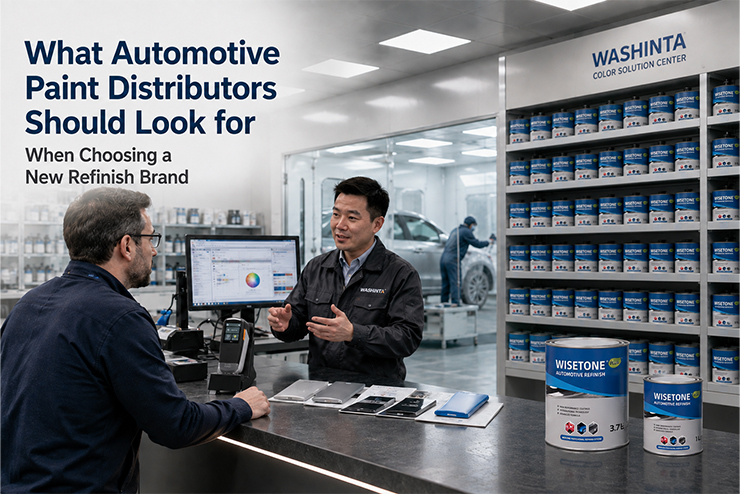
  • What Automotive Paint Distributors Should Look for When Choosing a New Refinish Brand
    What Automotive Paint Distributors Should Look for When Choosing a New Refinish Brand
    Sep 01, 2026
    Choosing a new automotive refinish brand is a major decision for any paint distributor. A new brand affects much more than the products on your shelves. It can influence your profit margins, inventory investment, technical workload, body shop relationships, and long-term competitiveness in your local market. For many years, distributors often focused on a few familiar questions: Is the quality good? Is the price competitive? Can the supplier deliver on time? Today, that is no longer enough. Vehicle colors are becoming more complex, Chinese EV brands are expanding into global markets, body shops expect faster repair cycles, and digital color-matching technology is becoming increasingly important. A competitive refinish brand therefore needs to provide more than paint. Here are eight key factors automotive paint distributors should evaluate before adding a new refinish brand to their portfolio. 1. Product Quality Must Be Consistent, Not Just Impressive Once Almost any supplier can prepare a good sample. The real test is whether the same performance can be maintained across different production batches and shipments. For a distributor, inconsistent quality can quickly become expensive. If clearcoat gloss changes between batches, basecoat color strength fluctuates, drying performance becomes unpredictable, or primers behave differently from one shipment to another, body shops will notice. And when body shops experience problems, they usually contact the distributor first. When evaluating a new brand, look beyond the first product demonstration. Consider: ·         Batch-to-batch consistency ·         Application stability ·         Drying performance ·         Gloss and appearance ·         Color accuracy ·         Hardness and durability ·         Performance under different climatic conditions ·         Compatibility across the complete refinish system Reliable quality protects more than the product—it protects your reputation with your customers. 2. Look for a Complete Refinish System Selling individual products may generate orders. Selling a complete system can build customers. A competitive automotive refinish brand should ideally cover the major stages of the repair process: Primers & Surfacers → Color System → Basecoats → Clearcoats → Hardeners → Thinners → Ancillary Products Why does this matter? For distributors, a complete system can increase the value of each customer account. Instead of selling only one clearcoat or primer, you can gradually supply a larger percentage of the body shop’s paint requirements. For body shops, it also simplifies purchasing, application, technical support, and troubleshooting. Before choosing a new brand, therefore, ask: Can this supplier help us build a complete refinish business, or are we simply adding several products to our warehouse? The difference is significant. 3. The Color System Can Determine Whether the Brand Succeeds In automotive refinishing, product quality gets a brand into a body shop. Color matching often determines whether it stays there. Modern automotive colors are becoming increasingly difficult to reproduce accurately. Metallic finishes, pearls, effect pigments, multi-layer colors, and new EV colors all create additional challenges for repair shops. A modern refinish brand should therefore have a strong color infrastructure behind it. Distributors should evaluate: ·         Number and quality of available color formulas ·         Frequency of formula updates ·         Coverage of local vehicle brands ·         Coverage of new and emerging vehicle manufacturers ·         Spectrophotometer compatibility ·         Digital formula retrieval ·         Formula correction capabilities ·         Technical support for difficult colors A large formula database is useful, but the number alone is not enough. The real question is: How quickly can the system help a body shop find a practical, accurate formula for the vehicle in front of them? That is what creates value at workshop level. 4. Pay Attention to Chinese EV Color Coverage This is becoming particularly important in many international markets. Chinese vehicle manufacturers are expanding rapidly outside China, bringing new models, new color codes, and new effect finishes into repair markets. For distributors, this creates both a challenge and an opportunity. If local body shops begin repairing more Chinese vehicles but existing refinish systems have limited formula coverage, the distributor that can provide better color solutions may gain an important competitive advantage. When evaluating a new refinish brand, ask the supplier: How quickly do you develop formulas for newly launched Chinese vehicle colors? A manufacturer based close to the Chinese automotive industry may have an advantage in identifying new models, collecting color data, developing formulas, and updating the database. As Chinese vehicles become a larger part of the global car parc, this capability could become increasingly valuable. 5. Calculate Distributor Profitability, Not Just Purchase Price One of the biggest mistakes when evaluating a new brand is comparing only the supplier’s price list. Purchase price matters, but distributor profitability depends on much more. Consider: Purchase Cost Freight & Import Costs Inventory Investment Technical Support Costs Marketing Costs Claims & Rework ↓ Actual Distributor Margin A product that costs 10% less is not necessarily more profitable if it creates more complaints, requires excessive inventory, or is difficult to sell. At the same time, a very expensive brand can limit your margin and make it harder to compete in price-sensitive segments. The ideal refinish brand should provide a healthy balance between: Quality + Market Positioning + Competitive Cost + Distributor Margin Distributors should also evaluate whether the supplier provides enough pricing flexibility to build sustainable margins for different levels of the distribution network. Your goal should not simply be to buy cheaper paint. Your goal should be to build a profitable refinish business. 6. Evaluate Inventory Requirements and Supply Flexibility Automotive refinish systems can involve hundreds of SKUs. Color toners, clearcoats, primers, hardeners, thinners, additives, and different packaging sizes can quickly create a significant inventory investment. Before introducing a new brand, distributors should understand: ·         Minimum order quantities ·         Initial stock requirements ·         Product shelf life ·         Packaging options ·         Lead times ·         Production capacity ·         Reorder flexibility ·         Fast-moving versus slow-moving SKUs This becomes especially important when introducing a new brand into a market. A distributor usually does not want to invest heavily in slow-moving inventory before demand has been established. A flexible manufacturer should understand this challenge and help its partners build an appropriate starting product portfolio. The best suppliers do not simply ask: “How much can you order?” They also ask: “What product combination makes sense for your market?” 7. Technical Support Is Part of the Product Automotive refinish coatings are not simple commodities. Body shops may need assistance with color matching, spray application, drying conditions, polishing, blending, product selection, or troubleshooting. If the manufacturer cannot provide effective technical support, much of that responsibility falls on the distributor. That increases your operating cost. A strong refinish brand should support distributors with: ·         Technical data sheets ·         Application guidance ·         Color-matching support ·         Product training ·         Troubleshooting ·         New product training ·         Formula updates ·         Digital technical materials ·         Remote technical communication Technical support becomes especially important when converting a body shop from another brand. Painters are accustomed to their existing products and processes. A smooth transition requires more than dropping new products at the workshop. Good technical support can significantly reduce the difficulty of converting customers. 8. Ask What the Supplier Will Do to Help You Grow the Market This is where a supplier relationship becomes a partnership. A distributor does not only need products. It needs tools to sell those products. When evaluating a new brand, ask whether the manufacturer can support: ·         Product catalogs ·         Technical documentation ·         Product images ·         Promotional materials ·         Social media content ·         Product demonstrations ·         Training materials ·         Exhibition support ·         Localized language materials ·         OEM/private-label packaging ·         Distributor development These resources can be particularly valuable for distributors launching a new brand. A manufacturer that understands marketing and distributor development can help shorten the time between importing products and generating real market demand. A Simple Distributor Evaluation Scorecard Before signing with a new automotive refinish brand, compare suppliers across the areas that directly affect your business. Evaluation Area Key Question Product Quality Is performance consistent across batches? Product Range Can we offer customers a complete refinish system? Color System Can body shops match colors efficiently? Vehicle Coverage Does the database cover the vehicles in our market? New EV Colors How quickly are new formulas developed? Profitability Is there enough sustainable distributor margin? Inventory Can we start and grow without excessive stock? Supply Are production and delivery reliable? Technical Support Can the supplier help solve real workshop problems? Marketing Support Will the manufacturer help us develop the market? Do not evaluate these factors independently. The strongest refinish brand is usually the one that provides the best overall business package. Think Beyond Paint: Choose a Business Platform The automotive refinish industry is changing. Body shops want faster turnaround. Painters want easier and more accurate color matching. Distributors want better margins. New vehicle brands are entering global markets. Digital tools are becoming increasingly important. This means the traditional supplier model— Manufacturer → Paint → Distributor → Body Shop —is evolving. A stronger model looks more like: Manufacturer + Products + Color Technology + Technical Support + Market Support ↓ Distributor ↓ More Competitive Body Shop Solution For distributors, this distinction matters. The right refinish brand should not only help you sell more paint. It should help you attract workshops, retain customers, improve profitability, and respond to changes in the vehicle market. WASHINTA: Supporting Automotive Refinish Distributors for Long-Term Growth Founded in 1997, Washinta Chemical Coating Co., Ltd. (WASHINTA) specializes in automotive refinish coatings and color solutions for international markets. WASHINTA provides a comprehensive automotive refinish portfolio covering color systems, basecoats, primers, clearcoats, hardeners, thinners, and related products. At the center of its color solution is WISETONE PLUS, an intelligent color-matching system developed to help distributors and body shops improve color retrieval and matching efficiency. The system combines: ·         100,000+ color formulas ·         Continuous formula database updates ·         Spectrophotometer-supported color matching ·         Intelligent formula retrieval ·         Support for a growing range of Chinese vehicle colors ·         Multi-language digital access For international distributors, WASHINTA can also provide OEM and private-label solutions, technical support, product training, customized marketing materials, and market-oriented product portfolio development. Our objective is simple: We don’t just want to supply paint. We want to help our distributors build stronger automotive refinish businesses. Looking for a New Automotive Refinish Brand? Whether you are an established automotive paint distributor, importer, regional wholesaler, or an entrepreneur developing a new refinish brand, choosing the right manufacturing partner can determine how competitive your business becomes. Evaluate more than price. Look at the products. Look at the color system. Look at the technical capabilities. Look at the margin opportunity. And most importantly, look at whether the manufacturer is prepared to grow with you. Interested in distributing WASHINTA products or developing your own automotive refinish brand? Contact WASHINTA to discuss distribution opportunities, OEM/private-label cooperation, automotive refinish products, and WISETONE PLUS color solutions. WASHINTA — Products. Color Technology. Partnership.
    続きを読む
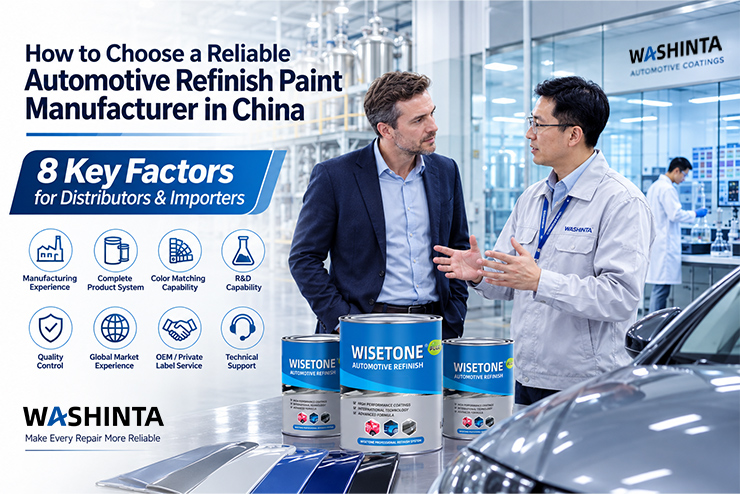
  • How to Choose a Reliable Automotive Refinish Paint Manufacturer in China
    How to Choose a Reliable Automotive Refinish Paint Manufacturer in China
    Aug 25, 2026
    China has become an important global manufacturing base for automotive refinish coatings. For distributors, importers, wholesalers, and automotive paint brands, sourcing from China can provide competitive pricing, flexible product solutions, and access to rapidly developing color-matching technologies. However, choosing the right supplier is about much more than comparing prices. Automotive refinish paint is a complete system involving color accuracy, coating performance, application stability, technical support, and long-term supply reliability. A good manufacturer should not simply provide paint—it should help its partners build a competitive and sustainable automotive refinish business. So, how can you identify a reliable automotive refinish paint manufacturer in China? Here are eight key factors to consider. 1. Manufacturing Experience and Industry Expertise Experience matters in automotive refinish coatings. Unlike many general industrial coatings, automotive refinishing requires consistent performance across different substrates, repair environments, climates, application techniques, and vehicle colors. When evaluating a manufacturer, consider: ·         How long has the company been producing automotive refinish coatings? ·         Does it operate its own manufacturing facility? ·         Does it have dedicated automotive refinish R&D capabilities? ·         Does it export to international markets? ·         Does it understand the requirements of professional body shops and paint distributors? An experienced manufacturer is generally better equipped to maintain product consistency, troubleshoot application problems, develop new products, and support distributors as their markets grow. 2. A Complete Automotive Refinish Product System A reliable supplier should offer more than a few popular clearcoats or primers. Professional distributors usually need a complete automotive refinish system that can cover the entire repair process, including: Color System → Primers & Surfacers → Basecoats → Clearcoats → Hardeners → Thinners → Ancillary Products Having a complete system provides several advantages. Products can be designed to work together, technical support becomes easier, inventory management is more efficient, and distributors can offer body shops a complete solution rather than individual products from multiple suppliers. When comparing manufacturers, therefore, evaluate the strength of the entire product portfolio—not only one or two products. 3. Strong Color Matching Capabilities Color matching is one of the most important factors in automotive refinishing. Modern vehicle colors are becoming increasingly complex. Metallics, pearls, effect pigments, multi-layer finishes, and new colors introduced by electric vehicle manufacturers can make accurate repair matching more challenging. A strong automotive paint manufacturer should therefore have more than a traditional formula database. Look for capabilities such as: ·         A continuously updated color formula database ·         Digital color retrieval ·         Spectrophotometer integration ·         Intelligent formula searching and correction ·         Color development for newly launched vehicle models ·         Technical support for difficult color matches The larger and more dynamic the vehicle market becomes, the more important these capabilities are. For distributors, a strong color system can also become a major competitive advantage when developing body shop customers. 4. R&D and Quality Control Capabilities Low price means little if product performance changes from batch to batch. Automotive refinish products require consistent viscosity, drying behavior, gloss, hardness, color accuracy, application performance, and durability. Before choosing a supplier, understand how the manufacturer manages quality. Important areas include: Raw Material Control Reliable manufacturers should have procedures for inspecting and controlling incoming raw materials. Production Process Control Mixing, dispersion, filling, and other production processes should follow standardized procedures. Laboratory Testing Products should be tested for relevant properties such as drying, gloss, adhesion, hardness, application performance, and storage stability. Batch Consistency For distributors, this is especially important. A product that performs differently between shipments can quickly damage customer confidence in the brand. A manufacturer with established R&D and quality-control systems is usually a safer long-term partner than a supplier competing mainly on price. 5. Certifications and International Market Experience Certifications provide useful evidence of a manufacturer’s quality-management and production capabilities, but certifications alone are not enough. International experience is equally important. A manufacturer serving overseas markets needs to understand: ·         Export documentation ·         Product labeling requirements ·         Packaging requirements ·         International logistics ·         Different climatic conditions ·         Distributor support ·         Market-specific product preferences Ask potential suppliers which markets they currently serve and how they support international customers. Experience working with overseas distributors can significantly reduce communication problems and make long-term cooperation easier. 6. OEM and Private Label Flexibility Many automotive refinish distributors want to develop their own brands rather than simply resell a manufacturer’s existing brand. If this is part of your strategy, evaluate the manufacturer’s OEM and private-label capabilities carefully. A capable partner should be able to support areas such as: ·         Product selection ·         Packaging customization ·         Label design ·         Product positioning ·         Different package sizes ·         Technical documentation ·         Marketing materials ·         Product portfolio development But flexibility should not mean sacrificing quality. The best OEM relationship is not simply: “Put my logo on your paint.” It should be: “Help me build a competitive automotive refinish product line for my market.” This difference becomes increasingly important as your distribution business grows. 7. Technical and After-Sales Support Automotive refinish coatings are technical products. Even a good product can produce poor results when the mixing ratio, thinner selection, spray technique, flash-off time, drying conditions, or polishing process is incorrect. For this reason, technical support should be part of your supplier evaluation. A reliable manufacturer should be able to assist with: ·         Product application ·         Color matching ·         Troubleshooting ·         Product training ·         Technical data ·         Formula support ·         New product introduction This is particularly important when entering a new market or launching a new brand. A supplier that responds quickly to technical problems can help distributors protect customer relationships and reduce unnecessary claims. 8. Think Beyond Price: Evaluate Long-Term Value Price is always important—but the cheapest quotation does not necessarily create the highest profit. Consider the total value of the partnership. For example, imagine Supplier A offers a slightly lower purchase price but provides limited color support, inconsistent batches, slow communication, and little technical assistance. Supplier B may have a slightly higher price but provides stable quality, a strong color system, regular formula updates, technical support, and reliable delivery. For a professional distributor, Supplier B may ultimately generate significantly more value. The real question should therefore not be: “Who offers the lowest price?” Instead, ask: “Which manufacturer can help us compete and grow in our market over the next five years?” A Practical Checklist for Evaluating Chinese Automotive Refinish Paint Manufacturers Before making a final decision, evaluate potential suppliers in these eight areas: Area What to Check Manufacturing Factory, production capacity, industry experience Product Range Complete automotive refinish system Color System Formula database, updates, digital matching R&D Laboratory, product development, technical team Quality QC procedures, batch consistency, certifications Global Experience Export markets and distributor experience Customization OEM, private label, packaging and documentation Support Training, color support and troubleshooting Ideally, request samples and conduct real application tests before making a large commercial commitment. A factory visit—either in person or through a detailed video inspection—can also provide valuable insight into the manufacturer’s production, laboratory, warehouse, and quality-control capabilities. WASHINTA: More Than an Automotive Paint Supplier Founded in 1997, Washinta Chemical Coating Co., Ltd. specializes in the development and manufacturing of automotive refinish coatings and color solutions for international markets. With decades of experience in automotive coatings, WASHINTA provides a comprehensive product portfolio covering color systems, basecoats, clearcoats, primers, hardeners, thinners, and related refinish products. Beyond coatings, WASHINTA continues to invest in digital color technology. Its WISETONE PLUS Intelligent Color Matching System combines a growing database of 100,000+ color formulas, digital color retrieval, spectrophotometer-supported matching, and continuous formula updates to help distributors and body shops improve color-matching efficiency. WASHINTA also supports international partners with: ·         Complete automotive refinish product systems ·         OEM and private-label solutions ·         Technical and color-matching support ·         Customized packaging and product portfolios ·         Distributor development support ·         Global export and logistics experience For distributors, importers, and automotive refinish brands, choosing a manufacturer is not simply a sourcing decision. It is a decision about the competitiveness of your business. Looking for an Automotive Refinish Paint Manufacturer in China? Whether you are looking to distribute an established automotive refinish system, develop your own private-label product line, or upgrade your current color-matching solution, WASHINTA can provide products, technology, and technical support tailored to your market. Talk to WASHINTA about automotive refinish coatings, OEM/private-label cooperation, or WISETONE PLUS color solutions. WASHINTA — Your Reliable Partner in Automotive Refinishing.
    続きを読む

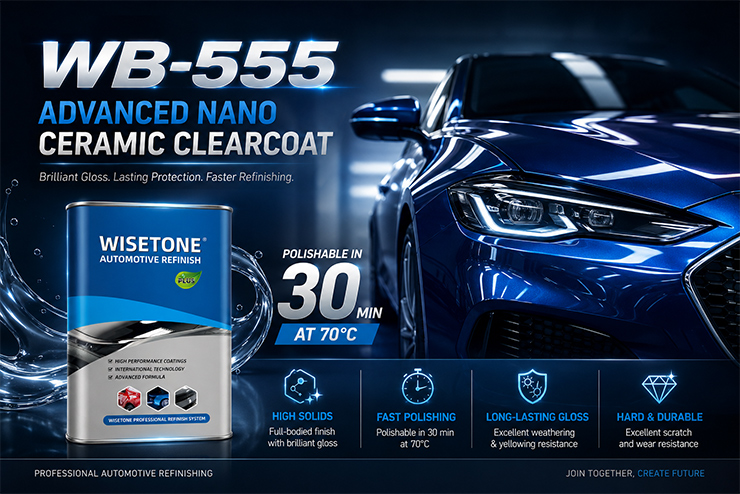
  • WB-555 Nano Ceramic Clear Coat | High-Solids Automotive Clear Coat
    WB-555 Nano Ceramic Clear Coat | High-Solids Automotive Clear Coat
    Aug 19, 2026
    WB-555 Nano Ceramic Clear Coat: High-Solids Automotive Clear Coat for Fast and High-Gloss Refinishing In professional automotive refinishing, a high-quality clear coat plays a critical role in the final appearance, durability, and efficiency of a repair job. A clear coat must provide more than gloss—it needs to deliver reliable application, fast drying, good hardness, weather resistance, and consistent performance under different workshop conditions. Washinta WB-555 Nano Ceramic Clear Coat is a newly developed high-solids 2K PU automotive clear coat designed for professional automotive refinishing. With a high-solids formulation, excellent flow, strong gloss retention, fast low-temperature baking, and a cured hardness of up to 1H, WB-555 is designed to help body shops achieve a high-quality finish while improving repair efficiency. For professional distributors, importers, and automotive body shops looking for a reliable high-solids automotive clear coat, WB-555 offers a combination of appearance, durability, and fast repair performance. What Is WB-555 Nano Ceramic Clear Coat? WB-555 Nano Ceramic Clear Coat is a professional 2K polyurethane automotive clear coat developed for use over Washinta's compatible 1K solvent-based and 1K waterborne basecoats. Its high-solids formulation produces a full and rich film build, while its balanced drying speed allows the coating to flow smoothly without drying too quickly on the surface. The result is a clear, high-gloss finish with good surface appearance and consistent film performance. WB-555 is particularly suitable for professional body shops that need to balance finish quality and repair speed. Key Benefits of WB-555 Automotive Clear Coat 1. High-Solids Formula for a Full Film Build WB-555 features a high-solids, high-concentration formulation designed to provide a full and substantial clear film. A high-solids clear coat can help professional painters achieve the desired film build efficiently while maintaining a smooth and attractive surface appearance. For body shops, this means the clear coat can provide a rich finish without requiring unnecessarily complicated application procedures. 2. Excellent Flow and High Gloss Surface appearance is one of the most important factors in automotive refinishing. WB-555 is formulated with a balanced drying speed that provides sufficient time for the coating to flow and level. This helps reduce the risk of: Excessive surface dust Rough particles Poor leveling Uneven appearance After curing, WB-555 provides a clear, transparent and high-gloss finish, helping repaired panels achieve a professional appearance. 3. Long-Term Weather Resistance and Anti-Yellowing Performance Automotive refinishing coatings are continuously exposed to sunlight, temperature changes, humidity, and other environmental conditions. WB-555 is designed for long-term weather resistance and yellowing resistance, helping maintain the appearance of the repaired vehicle over time. Its formulation is designed to support long-lasting: Gloss retention + color stability + clear appearance This makes WB-555 suitable for professional refinishing applications where long-term appearance is important. 4. Wide Application Window and Good Sag Resistance Different repair environments can create different application challenges. WB-555 has a wide spray application tolerance, helping painters achieve consistent results under a broader range of workshop conditions. Its formulation provides good resistance to sagging on vertical surfaces while maintaining good flow and leveling. In high-humidity environments, WB-555 is also designed to reduce the risk of whitening or blushing during application. This combination gives professional painters a greater margin for application errors and helps improve overall refinishing consistency. 5. Fast Low-Temperature Baking at 70°C One of the major advantages of WB-555 is its fast baking performance. Under the recommended baking conditions: 70°C × 30 minutes → Polishable This low-temperature fast-baking process allows body shops to move repaired vehicles through the refinishing process more efficiently. After cooling, the surface can be polished directly. For workshops operating with high repair volumes, this can help shorten the overall repair cycle and support faster vehicle delivery. Why Fast Baking Matters in Automotive Refinishing A faster curing process can help body shops: Reduce vehicle turnaround time Improve booth utilization Increase daily repair capacity Support same-day or fast repair jobs Get vehicles ready for polishing sooner For professional collision repair facilities, repair efficiency is directly connected to productivity and profitability. 6. Fast Hardness Development and 1H Final Hardness WB-555 is designed to develop hardness quickly under normal room-temperature conditions. After overnight curing, the hardness increases rapidly, providing good resistance to everyday wear and scratches. After complete curing, the coating can reach a hardness of approximately: 1H According to internal product testing, its cured hardness performance is close to that of imported 447-type clear coat products. This combination of hardness and surface appearance makes WB-555 suitable for professional automotive refinishing applications requiring a durable clear finish. 7. Direct Baking After Normal Spraying Another important feature of WB-555 is its compatibility with direct baking after normal spraying. Under recommended application conditions, the coating can be heated for baking without easily developing surface defects such as pinholes or “fish-eye-like” blistering effects associated with improper application or moisture contamination. This gives professional painters a more convenient workflow: Spray → Flash Off → Bake → Cool → Polish A controlled workflow can help reduce unnecessary waiting time in busy body shops. 8. Consistent Gloss After Baking Some clear coats can experience gloss changes or noticeable shrinkage during the curing process. WB-555 is formulated to minimize shrinkage after baking and maintain a consistent surface appearance. After drying and curing, the clear coat is designed to maintain its high-gloss appearance. This helps professional body shops achieve a more stable final finish from the spray booth through the polishing stage. Recommended Application of WB-555 For professional refinishing applications, correct mixing and application are essential for achieving the best performance. Recommended Mixing Ratio WB-555 Clear Coat : WB-355 Standard Hardener = 100 : 50 The recommended standard hardener is: WB-355 Standard Hardener Always follow the latest official technical data sheet and product label before use. Pot Life Recommended pot life: Approximately 80 minutes at 20–25°C The actual pot life can vary depending on temperature, humidity, mixing conditions, and workshop environment. For best results, prepare only the amount required for the current repair operation. Recommended Spray Viscosity Recommended spray viscosity: 15.5–16.5 seconds with a No. 4 viscosity cup Proper viscosity is important for achieving the desired atomization, flow, film build, and final gloss. Recommended Spray Application For professional automotive refinishing, WB-555 is recommended for wet-on-wet application with approximately 2–2.5 coats. Recommended parameters Application: Wet spray Recommended coats: 2–2.5 coats Spray pressure: 1–1.5 kgf/cm² Flash-off: Approximately 5 minutes at room temperature Flash-off endpoint: Until the surface is no longer stringy when touched appropriately 70°C baking: 30 minutes for polishing 70°C baking: 60 minutes for sanding and rework Air drying: Approximately 5 hours at room temperature before assembly and polishing Actual drying and curing performance may vary depending on ambient temperature, humidity, airflow, film thickness, and equipment. Spray Gun Setup Recommended spray gun specifications: Spray Gun Nozzle Size Gravity Feed Spray Gun 1.3–1.5 mm HVLP Gravity Feed Spray Gun 1.3–1.5 mm Proper spray gun setup and atomization are important for achieving uniform film build and maximum gloss. Compatible Basecoats WB-555 is designed for application over compatible Washinta 1K solvent-based and 1K waterborne automotive basecoats. The clear coat should be applied over a properly prepared, dry, and compatible basecoat surface. For complete compatibility information, professional users should refer to the latest Washinta technical documentation. WB-555 for Fast Automotive Refinishing Modern body shops need to balance three major requirements: Finish Quality + Durability + Repair Speed WB-555 is designed around these requirements. Its combination of high solids, excellent flow, high gloss, fast baking, rapid hardness development, and good application tolerance makes it suitable for professional automotive refinishing operations. A typical fast repair workflow can be: Basecoat → WB-555 Application → 5-Minute Flash-Off → 70°C/30-Minute Bake → Cooling → Polishing This workflow can help body shops reduce unnecessary waiting time and return repaired vehicles to customers faster. Why Choose a High-Solids Automotive Clear Coat? For professional refinishing, clear coat selection directly influences both the appearance and efficiency of a repair. A high-quality high-solids automotive clear coat should provide: High gloss Good flow and leveling Adequate film build Reliable hardness Scratch and wear resistance Weather resistance Anti-yellowing performance Consistent curing Good spray tolerance Efficient polishing WB-555 is developed to combine these requirements in one professional refinishing clear coat. WB-555 Nano Ceramic Clear Coat: Designed for Professional Body Shops WB-555 is not simply designed to produce a glossy surface. It is developed as a professional automotive refinishing clear coat that supports the complete repair workflow—from spraying and curing to polishing and vehicle delivery. For body shops, the key advantages are: High-solids film buildHigh gloss and excellent clarityGood flow and levelingAnti-yellowing and weather resistanceWide application toleranceGood vertical sag resistance70°C/30-minute fast bakingFast hardness developmentUp to 1H cured hardnessConsistent gloss after baking These features make WB-555 a strong option for repair shops seeking a balance between professional finish quality and efficient vehicle turnaround. Looking for a Professional Automotive Refinish Clear Coat Supplier? Washinta is a professional automotive refinish paint manufacturer with more than 30 years of manufacturing experience, established in 1997. Our automotive refinish product portfolio includes color toners, clearcoats, thinners, hardeners, and primers, with solutions developed for professional refinishing applications. For distributors, importers, regional dealers, and professional body shops, Washinta provides technical product information and support for automotive refinish coating solutions. If you are looking for a high-solids automotive clear coat, 2K PU clear coat, or nano ceramic clear coat for your market, contact Washinta to learn more about WB-555 and discuss potential distribution opportunities. Contact Washinta today for product information, technical documentation, samples, and distributor opportunities.
    続きを読む
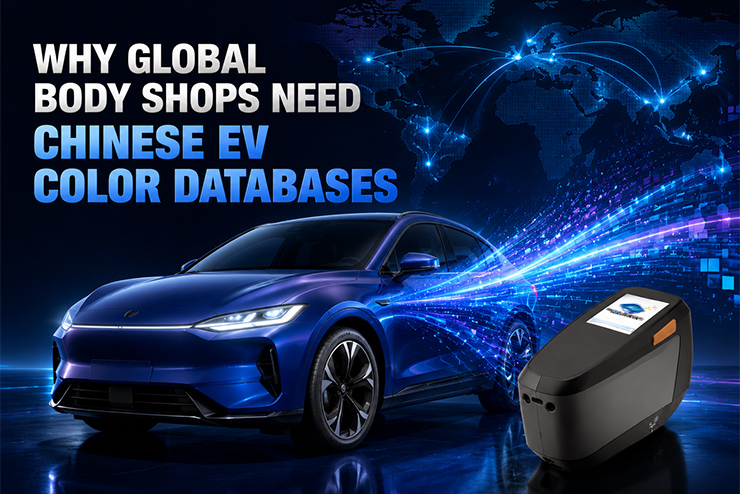
  • Why Global Body Shops Need Chinese EV Color Databases
    Why Global Body Shops Need Chinese EV Color Databases
    Jul 31, 2026
    The global automotive industry is rapidly changing — and nowhere is this transformation more visible than in the electric vehicle market. Chinese EV brands such as BYD, NIO, XPENG, Zeekr, Li Auto, and Avatr are expanding into Europe, the Middle East, Southeast Asia, South America, and many other international markets at an incredible speed. As these vehicles enter global roads, body shops worldwide are facing a new challenge:   Traditional automotive paint databases are struggling to keep up with Chinese EV colors. For modern automotive refinishing operations, access to accurate Chinese EV color databases is becoming increasingly essential. The Rise of Chinese EV Brands Worldwide Over the past few years, Chinese EV manufacturers have become major players in the global automotive industry. Brands like: BYD NIO XPENG Zeekr Li Auto Avatr are no longer limited to the Chinese domestic market. Today, these vehicles are being exported globally and appearing in: European repair shops Middle Eastern dealerships Australian body shops Southeast Asian collision centers Latin American automotive markets As vehicle volume grows internationally, repair demand naturally follows. The Problem: Many Global Paint Databases Lack Chinese EV Coverage Most traditional automotive paint systems were originally developed around: European brands Japanese brands American OEM vehicles As a result, many refinishing systems still have: Limited Chinese EV formulas Delayed formula updates Incomplete color variants Weak support for newly released EV colors This creates major difficulties for body shops trying to repair newer Chinese EV models accurately. Technicians often experience: Missing formulas Poor color matches Time-consuming manual adjustments Increased rework Material waste For busy body shops, this directly affects profitability and customer satisfaction. Chinese EV Colors Are Technically More Complex Modern Chinese EV manufacturers place heavy emphasis on exterior design and futuristic visual identity. Compared with traditional automotive colors, many Chinese EV finishes feature: Ultra-fine metallic particles High chromatic pearl effects Multi-layer translucent structures Strong flop and angle-changing effects Advanced tinted clearcoat systems These colors are visually impressive — but much more difficult to repair. Even small differences in: Spray pressure Film thickness Metallic orientation Blending technique can dramatically change the final appearance. Without accurate formula data, achieving an OEM-level repair becomes extremely difficult. Faster Color Updates Create New Challenges Chinese EV manufacturers release new colors much faster than traditional automotive brands. New: limited editions technology-inspired colors matte finishes satin textures gradient metallic effects are introduced every year. This fast product cycle means body shops need continuously updated color databases to stay competitive. A formula database that is updated slowly may already be outdated by the time a new EV model enters the local market. Why Accurate EV Color Databases Matter An advanced Chinese EV color database helps body shops: Find formulas faster Reduce color matching errors Minimize repainting and rework Improve repair efficiency Reduce paint material waste Increase customer satisfaction For collision centers handling increasing EV repair volume, accurate formula support becomes a major operational advantage. AI and Spectrophotometers Are Changing Color Matching Modern EV refinishing increasingly depends on: AI-assisted formula retrieval Spectrophotometers Digital color analysis Large-scale color databases Multi-angle color measurement Traditional manual color matching methods are no longer sufficient for many modern EV finishes. Professional body shops are now moving toward smarter, data-driven refinishing systems. Chinese EV Databases Are Becoming a Competitive Advantage As Chinese EV exports continue growing globally, body shops that can repair these vehicles accurately will gain a significant market advantage. Repair centers that lack Chinese EV color support may struggle with: Longer repair times Higher labor costs Customer complaints Poor finish consistency Meanwhile, shops with advanced Chinese EV color databases can: Complete repairs faster Deliver better color accuracy Improve operational efficiency Build stronger reputation in EV repairs The Future of Automotive Refinishing Is EV-Focused The automotive refinishing industry is entering a new era. In the past, body shops mainly focused on traditional OEM colors from Europe, Japan, and the United States. Today, EV-driven color innovation is changing the market rapidly — and Chinese EV manufacturers are leading much of this transformation. For global body shops, investing in Chinese EV color database support is no longer optional. It is becoming essential for: accurate repairs profitable operations future competitiveness long-term growth Final Thoughts The global expansion of Chinese EV brands is reshaping the automotive refinishing industry. As these vehicles become more common worldwide, body shops need smarter tools and more advanced color support systems to meet growing repair demands. Accurate Chinese EV color databases help body shops: reduce rework improve efficiency increase repair quality stay competitive in the evolving EV market   In the future, successful automotive refinishing businesses will not simply be the ones with good painters — they will be the ones with the best color data.  
    続きを読む
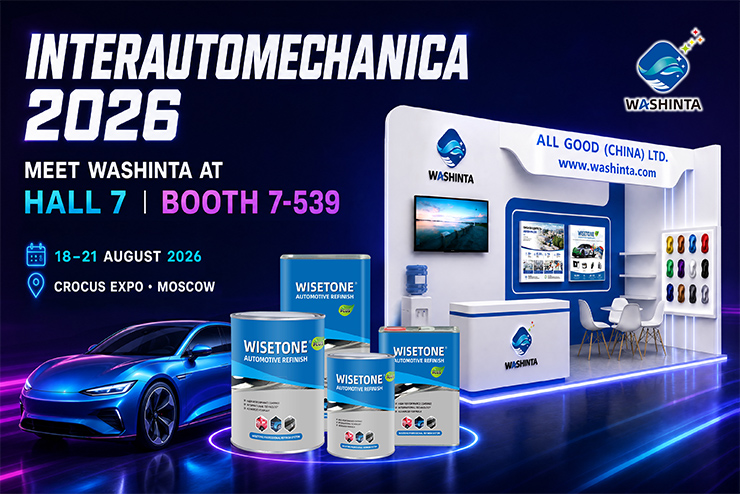
  • Washinta at INTERAUTOMECHANICA 2026 Moscow
    Washinta at INTERAUTOMECHANICA 2026 Moscow
    Jul 28, 2026
    Washinta to Exhibit at INTERAUTOMECHANICA 2026 Moscow – Discover Professional Automotive Refinish Solutions Published: 2026 Washinta, a professional automotive refinish paint manufacturer from China, is pleased to announce our participation in INTERAUTOMECHANICA 2026, one of the important automotive aftermarket exhibitions in Russia. We warmly invite distributors, importers, body shop professionals, and automotive industry partners to visit our booth and explore opportunities for long-term cooperation. Meet Washinta at INTERAUTOMECHANICA 2026 📅 Date: 18–21 August 2026 📍 Venue: Crocus Expo, Moscow, Russia 🏢 Hall 7 | Booth 7-539 During the exhibition, visitors will have the opportunity to discover Washinta’s professional solutions for automotive refinishing, including advanced paint systems, high-performance clearcoats, primers, hardeners, and intelligent color matching solutions. Professional Automotive Refinish Paint Solutions With more than 30 years of experience in automotive refinish coating manufacturing, Washinta is committed to providing reliable products and technical solutions for customers worldwide. Our product portfolio includes: Automotive refinish paint systems High-performance clearcoats Primers and hardeners Color toner systems Digital color matching solutions We continuously improve our technology and production capabilities to help distributors and body shops achieve better repair efficiency, stable quality, and increased profitability. WISETONE PLUS Smart Color Matching System At INTERAUTOMECHANICA 2026, Washinta will also showcase our WISETONE PLUS Color Matching System, designed to support modern body shops and automotive paint professionals. Key advantages include: ✔ Over 100,000 color formulas ✔ Smart formula matching technology ✔ Chinese EV color coverage ✔ Continuous database updates ✔ Compatible with professional spectrophotometers for AI-assisted formula optimization By combining digital technology with automotive refinishing expertise, WISETONE PLUS helps users achieve faster and more accurate color matching results. Looking for Distribution Partners in Russia and CIS Markets Washinta is actively expanding cooperation with international partners and welcomes: Automotive paint distributors Regional dealers Importers and wholesalers Body shop groups Strategic business partners We provide professional product support, technical assistance, and long-term cooperation opportunities for partners who want to grow in the automotive aftermarket. Visit Our Booth and Discuss Future Cooperation Russia and CIS markets represent important opportunities for automotive aftermarket development. At INTERAUTOMECHANICA 2026, we look forward to meeting industry professionals, sharing our latest automotive refinishing solutions, and exploring new business opportunities. If you are looking for a reliable Chinese automotive refinish paint manufacturer, we welcome you to visit Washinta at: 📍 INTERAUTOMECHANICA 2026 🏢 Hall 7 | Booth 7-539 📅 18–21 August 2026 📌 Crocus Expo, Moscow Contact us today to schedule a meeting during the exhibition. 🌐 www.washinta.com About Washinta Washinta is a professional automotive refinish coating manufacturer based in China, specializing in automotive repair paint systems and color matching solutions. With advanced manufacturing facilities, strict quality control, and more than 30 years of industry experience, Washinta supports customers and partners in more than 70 countries worldwide.
    続きを読む
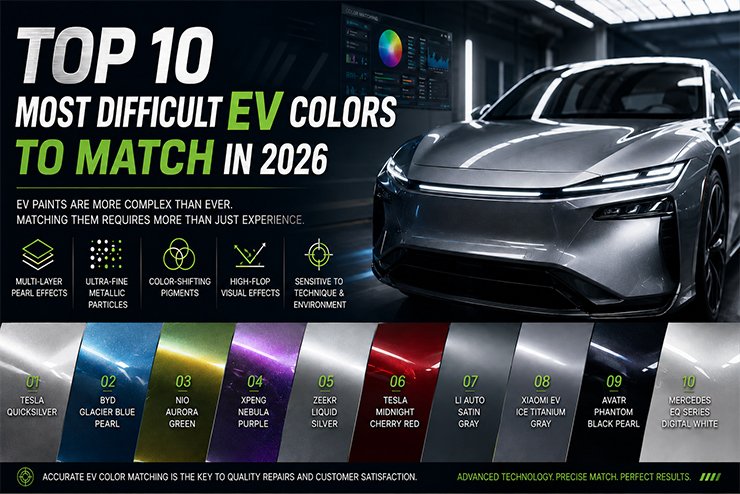
  • Top 10 Most Difficult EV Colors to Match in 2026
    Top 10 Most Difficult EV Colors to Match in 2026
    Jul 17, 2026
    As electric vehicles continue to dominate global automotive markets, body shops are facing a new challenge: EV paint colors are becoming significantly more difficult to repair and match. Unlike traditional solid colors, many modern EV finishes feature: Ultra-fine metallic particles Multi-layer pearl effects Transparent tinted coatings Color-shifting pigments High-flop visual effects under different lighting angles For automotive refinishing professionals, achieving a perfect color match on modern EVs now requires more advanced color databases, spectrophotometers, and intelligent mixing systems than ever before. Here are the Top 10 most difficult EV colors to match in 2026. 1. Tesla Quicksilver Tesla’s Quicksilver remains one of the most challenging colors in the industry. Why It’s Difficult: Extremely fine aluminum metallic particles Strong brightness variation under lighting Sensitive spray pressure and application technique High flop effect from different viewing angles Even slight differences in spray gun distance or atomization can noticeably change the final appearance. 2. BYD Glacier Blue Pearl BYD has rapidly expanded globally, and Glacier Blue Pearl has become a common repair challenge for body shops. Why It’s Difficult: Multi-layer pearl structure Transparent blue tint effect Color shifts heavily between sunlight and indoor lighting Difficult blend transitions Many traditional paint databases still lack stable formula coverage for newer BYD colors. 3. NIO Aurora Green NIO’s premium EV finishes are designed with luxury-level visual depth. Why It’s Difficult: High chromatic pearl pigments Green-to-gold color movement Strong sensitivity to film thickness Requires extremely controlled blending technique This color often appears different depending on viewing distance and weather conditions. 4. XPENG Nebula Purple Nebula Purple is one of the most visually dynamic EV colors released in recent years. Why It’s Difficult: Multi-angle color-changing effect Violet and blue interference pearls Difficult orientation control of metallic particles Easy to create patchiness during repair Without accurate formula data and spray-out verification, repairs can become highly inconsistent. 5. Zeekr Liquid Silver Silver has always been difficult in automotive refinishing, but Zeekr’s Liquid Silver takes complexity to another level. Why It’s Difficult: Ultra-bright metallic reflection Highly uniform particle arrangement required Strong sensitivity to reducer speed and air pressure Visible mismatch even with slight metallic orientation changes This color is especially difficult on large side panels and doors. 6. Tesla Midnight Cherry Red Tesla’s Midnight Cherry Red combines deep candy-style transparency with layered metallic effects. Why It’s Difficult: Semi-transparent red layer Strong depth perception effect Requires precise layer control Difficult to reproduce factory richness Repairing this finish often requires advanced blending skills and accurate spray-out cards. 7. Li Auto Satin Gray Matte and satin EV finishes continue growing in popularity. Why It’s Difficult: Surface texture affects final appearance Gloss level consistency is critical Spot repairs are extremely difficult Small blending errors become highly visible Unlike gloss finishes, matte repairs cannot rely on polishing to correct defects. 8. Xiaomi EV Ice Titanium Gray As Xiaomi enters the EV market, its modern technology-inspired colors are gaining attention. Why It’s Difficult: Fine titanium metallic particles Strong cool-tone reflection Highly angle-sensitive brightness Demands accurate spectrophotometer readings This color can appear completely different under LED lighting versus natural daylight. 9. Avatr Phantom Black Pearl Black colors may appear simple, but modern pearl blacks are among the hardest finishes to repair perfectly. Why It’s Difficult: Hidden blue and purple pearl layers Extremely sensitive to texture differences Clearcoat thickness strongly affects appearance Difficult to maintain consistent gloss depth Even minor sanding or blending variations become visible under sunlight. 10. Mercedes EQ Series Digital White Luxury EV brands are introducing highly refined whites with hidden pearl structures. Why It’s Difficult: Multiple pearl particle sizes Extremely clean color requirement Sensitive to contamination and toner imbalance Difficult coverage consistency White colors are unforgiving — even small formula inaccuracies can create visible panel differences. Why EV Colors Are Becoming Harder to Match Modern EV manufacturers are using advanced color technologies to create stronger visual identity and futuristic appearance. Compared with traditional automotive colors, EV finishes now feature: More complex pigments More pearl layers Stronger flop effects More transparent color structures Faster color updates between model years As a result, traditional refinishing systems are struggling to keep up. How Professional Body Shops Improve EV Color Matching To successfully repair modern EV finishes, body shops increasingly rely on: AI-assisted color matching systems Spectrophotometers Large global color formula databases Continuous EV color updates Spray-out card verification Advanced blending techniques The ability to accurately repair EV colors is quickly becoming a major competitive advantage for body shops worldwide. The Future of Automotive Color Matching As EV design continues evolving, automotive paint technology will become even more sophisticated. Body shops that invest in modern color matching solutions today will be better prepared for: New EV color trends Faster repair cycles Reduced rework Higher customer satisfaction In 2026 and beyond, accurate EV color matching is no longer optional — it is essential for profitable automotive refinishing operations.  
    続きを読む
  • How to Choose the Best Automotive Refinish Paint Manufacturer in China
    How to Choose the Best Automotive Refinish Paint Manufacturer in China
    Jul 17, 2026
      Introduction   China has become one of the world's leading manufacturing hubs for automotive refinish paint. Today, thousands of distributors, importers, wholesalers, and private-label brands source automotive refinishing products from Chinese manufacturers due to competitive pricing, advanced production technology, and continuous product innovation.   However, not all manufacturers offer the same level of quality, technical expertise, or long-term business support. Choosing the wrong supplier can result in inconsistent product quality, delayed shipments, poor color accuracy, and dissatisfied customers.   Whether you are planning to launch your own automotive paint brand, expand your product portfolio, or become a regional distributor, selecting the right manufacturing partner is one of the most important business decisions you will make.   In this comprehensive guide, we will explain the key factors every buyer should evaluate before selecting an automotive refinish paint manufacturer in China. You'll also learn what separates a reliable long-term partner from an ordinary supplier. Why Are More Global Buyers Choosing Automotive Paint Manufacturers in China?   Over the past two decades, China has evolved from a low-cost manufacturing base into one of the world's most advanced automotive coatings production centers.   Many international automotive refinish paint brands now cooperate with Chinese factories for OEM manufacturing, product development, and global distribution. Continuous investment in production equipment, research laboratories, and quality management systems has enabled Chinese manufacturers to supply products that meet international market requirements.   Today, buyers from Latin America, Southeast Asia, the Middle East, Africa, and Eastern Europe increasingly choose Chinese suppliers because they offer:   Competitive manufacturing costs Stable production capacity Flexible OEM and private label services Complete automotive refinish product systems Faster product development Professional export experience Continuous technical support   For distributors, partnering with the right Chinese manufacturer can improve profitability while maintaining consistent product quality for customers.   What Makes a Professional Automotive Refinish Paint Manufacturer?   Choosing a supplier should never be based solely on price.   Professional manufacturers invest heavily in research, quality control, production management, and customer support to ensure long-term business success.   Below are the most important factors every buyer should consider.   1. Manufacturing Experience   Experience is one of the strongest indicators of a manufacturer's reliability.   Automotive refinish coatings require years of formulation expertise, production management, and market feedback. Manufacturers with decades of experience are generally better equipped to produce consistent products, solve technical challenges, and adapt to changing market demands.   When evaluating a supplier, ask questions such as:   How many years have they specialized in automotive refinish paint? Do they manufacture products themselves? Have they supplied international markets? Can they provide long-term technical support?   A manufacturer with extensive industry experience is more likely to become a stable long-term partner rather than simply a product supplier.   2. Complete Product Portfolio   Professional distributors prefer manufacturers capable of supplying an entire automotive refinishing system rather than individual products.   A complete product range typically includes:   Automotive Color Toners HS & MS Clearcoats Hardeners Thinners Primers Polyester Putty Plastic Primer Degreasers Spot Repair Products Color Matching Software Spectrophotometer Integration   Working with a single supplier helps ensure compatibility between products while simplifying purchasing, logistics, and technical support.   3. Product Quality and Consistency   Consistent quality is essential for building customer trust.   Professional manufacturers implement strict quality control throughout every stage of production, including:   Raw material inspection Formula verification Batch consistency testing Viscosity control Gloss measurement Adhesion testing Drying performance evaluation Packaging inspection 4. Production Capacity and Manufacturing Facilities Production capacity is often overlooked when selecting an automotive refinish paint manufacturer, yet it directly affects delivery reliability, product consistency, and your ability to grow your business. A professional manufacturer should have modern production facilities capable of meeting both small and large-volume orders without compromising quality. When evaluating a factory, consider asking: What is the annual production capacity? How many production lines are in operation? Can the factory handle seasonal demand increases? What is the average lead time for OEM orders? Are production and packaging completed in-house? If possible, request a factory tour or a live video inspection. Seeing the production lines, raw material storage, laboratories, and packaging facilities provides valuable insight into the manufacturer's capabilities. A well-organized factory demonstrates professionalism, efficient management, and a long-term commitment to quality. 5. Research and Development Capabilities The automotive industry is constantly evolving. New vehicle models, paint technologies, environmental regulations, and customer expectations require manufacturers to continuously improve their products. A reliable automotive refinish paint manufacturer should have a dedicated research and development (R&D) team capable of: Developing new products Improving existing formulas Testing raw materials Meeting international VOC requirements Supporting OEM customization Responding quickly to market changes Innovation is especially important as electric vehicles introduce more complex factory colors and special-effect finishes. Manufacturers that invest in R&D are better prepared to support distributors in highly competitive markets. 6. Color Matching Technology Is Becoming More Important Than Ever One of the biggest challenges facing modern body shops is accurate color matching. Today's vehicles feature increasingly sophisticated colors, including: Pearl finishes Metallic colors Xirallic effects Three-stage paints Matte finishes High-chroma colors These finishes require more than traditional color cards or manual adjustments. Leading manufacturers now provide intelligent color matching solutions that combine: Digital color formula databases Spectrophotometer integration AI-assisted formula correction Continuous software updates Cloud-based color management This technology helps body shops reduce repainting, improve first-time match accuracy, and minimize paint waste. For distributors, offering advanced color matching solutions adds significant value beyond simply selling paint products. 7. Chinese EV Colors Are Creating New Business Opportunities The rapid expansion of Chinese electric vehicle brands is changing the global automotive refinish market. Brands such as: BYD NIO XPENG Li Auto Zeekr are now exported to dozens of countries across Latin America, Southeast Asia, the Middle East, Europe, and Africa. As these vehicles become more common on local roads, repair shops face a growing challenge: accurately matching newly developed OEM colors. Many traditional color databases cannot fully support these newer vehicle colors, leading to longer repair times and customer dissatisfaction. When choosing a manufacturer, ask whether they continuously update their color database to include the latest Chinese EV colors. Manufacturers that invest in modern color matching technology can help distributors stay ahead of future market demand. 8. OEM and Private Label Services Many importers prefer selling products under their own brand instead of distributing an existing manufacturer brand. A professional automotive paint manufacturer should offer comprehensive OEM and private label services, including: Custom branding Label design Packaging customization Formula adjustment Marketing materials Product documentation Technical training Before selecting an OEM partner, ask: What is the minimum order quantity (MOQ)? Can packaging sizes be customized? Are multilingual labels available? Can the factory provide design support? How long does OEM production take? Choosing an experienced OEM manufacturer allows you to build a unique brand while benefiting from established production expertise. 9. International Certifications and Quality Management Certifications demonstrate that a manufacturer follows recognized quality management standards. Although certification requirements vary by market, buyers should verify whether the factory operates under internationally recognized systems. Common certifications include: ISO 9001 Quality Management ISO 14001 Environmental Management IATF 16949 Automotive Quality Management REACH compliance (where applicable) VOC compliance for target markets In addition to certifications, ask whether products undergo regular laboratory testing for: Adhesion Hardness Gloss retention Weather resistance Chemical resistance Drying performance Durability Reliable testing procedures reduce quality risks and improve customer satisfaction. 10. Export Experience Matters Manufacturing high-quality paint is only part of the equation. An experienced exporter understands the documentation, packaging, and logistics required for international shipments. Professional exporters should be able to provide: Technical Data Sheets (TDS) Safety Data Sheets (SDS/MSDS) Certificates of Origin Packing Lists Commercial Invoices Export Labels Dangerous Goods documentation (when required) Experienced suppliers are also familiar with shipping regulations and can help buyers avoid unnecessary customs delays. For first-time importers, this level of support is particularly valuable. 11. Technical Support After the Sale Many buyers focus only on price and overlook after-sales service. However, technical support becomes essential when introducing new products into a market. A professional manufacturer should offer assistance such as: Product application guidance Mixing ratio recommendations Troubleshooting Color matching assistance Marketing support Distributor training Online technical consultation Long-term technical support helps distributors build customer confidence while reducing complaints and product misuse.   Strong after-sales service is often what separates strategic partners from ordinary suppliers. 12. How to Identify a Real Automotive Paint Manufacturer vs. a Trading Company Not every company that claims to be a manufacturer actually owns a production facility. Many businesses are trading companies that source products from third-party factories. Working with a trading company is not necessarily a bad choice, but if your goal is long-term cooperation, OEM production, or exclusive distribution, partnering directly with a manufacturer usually provides greater advantages. Here are a few ways to identify a genuine manufacturer: Request a factory tour or live video inspection. Ask for photos or videos of production lines, laboratories, and warehouses. Verify whether the company develops its own formulations. Check if technical documents and product data sheets are created by the factory. Confirm whether OEM packaging is completed in-house. Review the company's manufacturing history and export experience. A transparent manufacturer will generally be happy to demonstrate its facilities and production capabilities. 13. Questions Every Buyer Should Ask Before Choosing a Supplier Before making a purchasing decision, prepare a checklist of key questions. Examples include: How many years have you specialized in automotive refinish paint? What products do you manufacture? Do you provide OEM or private label services? What certifications does your factory hold? What is your standard production lead time? Can you supply Technical Data Sheets (TDS) and Safety Data Sheets (SDS/MSDS)? What quality control procedures are used? Can you provide technical training? How often is your color formula database updated? Which countries do you currently export to? The answers to these questions will help you compare suppliers objectively instead of relying only on price. 14. Common Mistakes Buyers Should Avoid Many importers focus almost entirely on the lowest quotation. While competitive pricing is important, choosing a supplier based only on price often leads to higher long-term costs. Common mistakes include: Choosing the cheapest supplier Low prices may indicate inconsistent raw materials, limited quality control, or inadequate technical support. Ignoring color matching capabilities As vehicle colors become increasingly complex, accurate color matching has become one of the most important competitive advantages. Buying only individual products Purchasing clearcoat from one supplier and hardener from another may result in compatibility issues. Whenever possible, select a manufacturer capable of supplying a complete automotive refinish system. Overlooking after-sales support Technical assistance, distributor training, and application guidance can significantly improve customer satisfaction. Failing to evaluate long-term partnership potential The best supplier is not necessarily the one with the lowest price—it is the one that consistently helps your business grow. 15. Why Long-Term Partnerships Create More Value Successful distributors rarely change suppliers every year. Long-term cooperation offers many benefits, including: Stable product quality Better purchasing conditions Faster technical support Customized product development Marketing assistance Exclusive distribution opportunities Stronger customer confidence When both parties invest in a long-term relationship, they can grow together and respond more effectively to changing market demands. 16. Why More International Customers Choose Washinta Choosing the right automotive refinish paint manufacturer is about more than selecting products—it is about finding a partner committed to your long-term success. With more than 30 years of manufacturing experience, Washinta has built a reputation for delivering professional automotive refinish solutions to customers in over 70 countries and regions. Our product portfolio includes: Automotive Color Toners High-Performance Clearcoats Primers Hardeners Thinners Complete Automotive Refinish Systems To help distributors and body shops improve efficiency, we also provide the WISETONE PLUS Intelligent Color Mixing System, featuring: More than 100,000 color formulas Continuous database updates Support for the latest Chinese EV colors AI-assisted color correction Multi-language software Compatibility with professional spectrophotometers Whether you are looking for OEM manufacturing, private label production, or a reliable long-term supplier, Washinta is committed to delivering consistent quality, technical innovation, and dependable customer support. Conclusion China has become one of the world's leading sources for automotive refinish paint, offering buyers a wide range of manufacturing options. However, choosing the right supplier requires more than comparing prices. By carefully evaluating manufacturing experience, production capacity, product quality, research and development, color matching technology, OEM capabilities, certifications, export experience, and after-sales support, you can build a stronger and more profitable business.   A reliable manufacturing partner will not only supply products but also contribute to your long-term growth in an increasingly competitive automotive refinishing market.
    続きを読む
  • Visit WISETONE PLUS at INA PAACE Automechanika Mexico 2026 – Meet Your Trusted Automotive Refinish Paint Manufacturer
    Visit WISETONE PLUS at INA PAACE Automechanika Mexico 2026 – Meet Your Trusted Automotive Refinish Paint Manufacturer
    Jul 07, 2026
    Date: July 8–10, 2026 Booth No.: 1826-2 Hall 18   Meet WISETONE PLUS in Mexico!   WISETONE PLUS, the premium automotive refinish paint brand from Washinta, is excited to announce our participation in INA PAACE Automechanika Mexico 2026, one of the largest automotive aftermarket exhibitions in Latin America.   Together with our valued Mexican partner, we warmly invite distributors, importers, wholesalers, body shop owners, and automotive refinishing professionals to visit us and explore new business opportunities.   If you are looking for a reliable automotive refinish paint manufacturer, this is the perfect opportunity to meet our team face-to-face.   Discover Our Complete Automotive Refinish Solutions   At our booth, you will discover a full range of professional automotive refinishing products, including:   Automotive Color Toners 2K Clearcoats Primers Hardeners Thinners Low VOC Automotive Paint Systems WISETONE PLUS Color Mixing System AI Color Matching Technology Spectrophotometer Solutions   Our products are trusted by customers in more than 70 countries, helping distributors and body shops achieve accurate color matching, consistent quality, and higher repair efficiency.   Experience Our Advanced Color Matching Technology   One of the highlights at our booth will be the WISETONE PLUS Intelligent Color Matching System.   Visitors will experience:   Over 100,000+ color formulas Continuous formula database updates Chinese EV color coverage AI-assisted color correction Fast and accurate color matching Multi-language software support   As Chinese electric vehicles continue expanding into global markets, accurate color matching has become more important than ever. Our intelligent system helps body shops repair modern vehicle colors with greater confidence and efficiency.   Looking for Automotive Paint Distributors in Latin America   As part of our global expansion strategy, we are actively seeking:   Exclusive Distributors Regional Agents Importers Wholesalers Strategic Business Partners   We welcome partners from:   Mexico Guatemala Costa Rica Panama Colombia Ecuador Peru Chile Argentina Brazil Uruguay Paraguay Bolivia Dominican Republic Honduras El Salvador Nicaragua Belize   If you are interested in representing a professional automotive refinish paint brand, our team would be pleased to discuss exclusive cooperation opportunities during the exhibition.   Why Choose Washinta?   With more than 30 years of manufacturing experience, Washinta has become a trusted OEM and automotive refinishing solutions provider for customers around the world.   We offer:   Stable factory production OEM & Private Label Services Professional R&D Team Strict Quality Control International Certifications Fast Production & Delivery Technical Training and Marketing Support Continuous Product Innovation   Whether you are building your own automotive paint brand or expanding your existing business, Washinta provides reliable products and long-term partnership support.
    続きを読む
1 2 3 4
合計 4 ページ

伝言を残す

伝言を残す
弊社の製品にご興味があり、詳細を知りたい場合は、こちらにメッセージを残してください。できるだけ早く返信させていただきます。
提出する
お問い合わせ: kay@washinta.com

製品

ワッツアップ

接触